9 792 Podpisy
9 222 z 30 000 dla kworum w
Niemcy
Niemcy
Petycja jest adresowana do: German Bundestag, Petition Committee
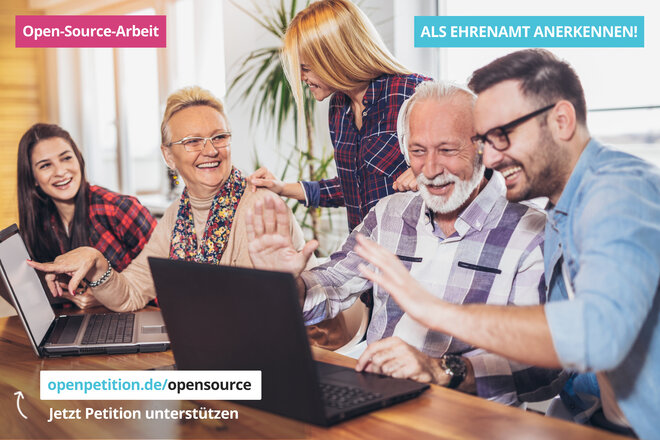
Open-Source-Software builds the foundations of digital infrastructure in big parts - in administration, economy, science and daily life. Even the current coalition agreement of the Federal Government mentions Open-Source-Software as a fundamental building block for the achievement of digital sovereignty.
However, the work done by thousands of volunteers for this goal is not recognised as volunteering, neither fiscally nor in terms of funding. This imbalance between societal importance and legal status has to be corrected.
Therefore, as an active contributor to Open-Source-Projects, I call for work on Open-Source to be recognised as volunteering for the common good – of equal rank as volunteer work for associations, youth work or ambulance service.
Uzasadnienie
1. Open-Source contributes evidently to the common good
- It is creating free, transparent and auditable software that is available for everyone.
- Critical systems like internet protocols, security libraries, health IT, AI frameworks, energy management, education technologies and communication tools are based significantly on volunteer contributions.
- Without this work, Germany would be digitally more dependent, less secure and less inventive.
Orientation on the common good is a central criterion for volunteering – and Open-Source fulfils it to the highest degree.
2. This work predominantly happens unpaid – and is voluntary civilian commitment
- The majority of all work on development, maintenance and documentation happens voluntarily in leisure time.
- Contributors take responsibility for security, stability and advancement of central software components, without getting paid and often recognised.
- The commitment is comparable to work in associations for the public good, but digitally.
The legal equalisation with traditional volunteering is therefore coherent.
3. Societal dependence without appreciation
- State facilities, town councils, schools and enterprises profit directly from Open-Source libraries, frameworks and tools.
- Security vulnerabilities like "Heartbleed" or "Log4Shell" have shown the importance of work by maintainers for the protection of the public.
- Concurrently, resources and structures are lacking, as the work is not formally recognised as volunteering – and does therefore not receive taxable or organisational benefits.
This creates an imbalance of responsibilities that lies on few volunteers, while millions of users are profiting.
4. Recognition as volunteering would create legal clarity
Possible results of formal recognition:
- Compensations could be paid tax-exempt (Ehrenamtspauschale/Übungsleiterpauschale).
- Open-Source projects for the common good could more easily receive a classification as per §52 AO.
- Contributors could get a better position in issues of liability (similar to §31a BGB for an Association's Board).
- Projects could legally reimburse expenses and issue donation receipts.
This creates transparency, legal clarity and sustainability in digital volunteer work.
5. Digitalisation needs competent volunteers – and those deserve funding
- Open-Source commitment requires high technical competence
- Volunteer developers perform work, that companies would otherwise need to buy for high hourly rates.
- The state invests billions in digitalisation, but ignores the people who maintain the technological foundation voluntarily.
Recognition as volunteer work would be a cost-efficient contribution to digital sovereignty in Germany.
6. Germany limps behind internationally
Other countries are already funding commitment to Open-Source through:
- Taxable benefits
- Institutional support
- Recognition of software development for the public good
Germany is risking to fall behind in international competition, if volunteers in the digital realm are structurally disadvantaged further.
Dziękujemy za wsparcie, Henning Lammert, Berlin
Pytanie do inicjatora
Informacje na temat petycji
Petycja rozpoczęta:
27.11.2025
Kolekcja kończy się:
23.05.2026
Region:
Niemcy
Kategoria:
Internetu
Ta petycja została przetłumaczona na następujące języki
Przetłumacz tę petycję teraz
Nowa wersja językowaDlaczego ludzie podpisują
Narzędzia do dystrybucji petycji.
Masz własną stronę internetową, bloga, a może cały portal? Zostań rzecznikiem i propagatorem tej petycji. Mamy banery, widżety i API (interfejs), aby zintegrować je z Twoimi stronami. Do narzędzi
Ta petycja została przetłumaczona na następujące języki
Przetłumacz tę petycję teraz
Nowa wersja językowaMoże Cię również zainteresować

34
Podpisy
111 dni
pozostały
864
Podpisy
43 dni
pozostały
Open Source contributes to the betterment of humanity, that is worth defining as volunteering.