
9 Unterschriften
9 von 30.000 für Quorum in
Deutschland
Deutschland
Diese Petition gibt es auch in Deutsch.
Petition richtet sich an: German Bundestag Committee on Petitions
Introduction and Problem Statement
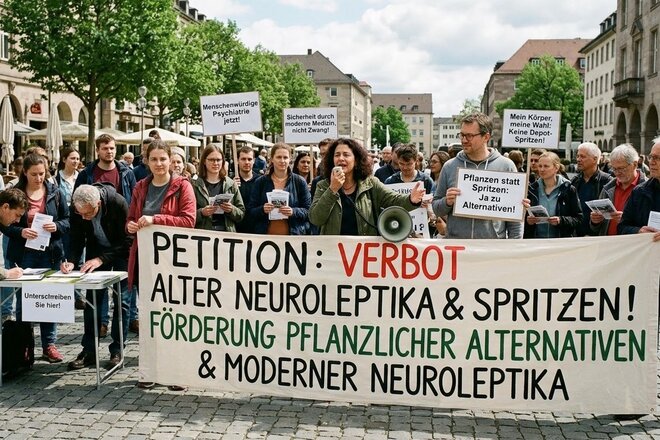
Patients and their relatives often experience a striking imbalance in decision-making when it comes to antipsychotic medication. Concerns regarding serious side effects are often given insufficient consideration in clinical practice, which is perceived by those affected as a form of stigmatisation and exclusion. In order to protect the quality of life, self-determination and physical health of those affected, we are making the following key demands of the Federal Government and the relevant stakeholders in the healthcare sector.
Demands of the petition
1. Re-evaluation and restriction of first-generation antipsychotics (‘old neuroleptics’)
Issue: First-hand accounts from those affected show that first-generation neuroleptics frequently have an unfavourable risk-benefit ratio.
Endocrine side effects: In particular, pronounced hyperprolactinaemia (a pathological increase in prolactin levels) leads to significant health impairments such as hormonal imbalances, loss of libido, loss of bone density and psychological distress.
Call to action: Prescribing standards must be critically reviewed, and outdated active substances with a high side-effect profile should be phased out of standard care in favour of better-tolerated alternatives.
2. Critical review and reduction of depot formulations (injections)
Pharmacokinetic concerns: With parenteral administration, the first-pass effect in the liver is bypassed. Direct absorption into the bloodstream can lead to altered efficacy and side-effect profiles compared with oral administration.
Withdrawal issues and habituation: The continuous release of the active substance makes dose adjustments and gradual tapering considerably more difficult.
Call to action: Depot injections must not be imposed as the standard solution. The focus must be on voluntary, oral administration, whereby patients retain full control over their treatment.
3. Research into and promotion of modern antipsychotics
Call to action: Targeted government funding and the preferential use of novel antipsychotics (e.g. newer-generation atypical antipsychotics), which have an improved side-effect profile and minimise the risk of motor and metabolic complications.
4. Integration and validation of herbal alternatives
Call: Intensification of research into phytotherapeutic and sedative active ingredients. Herbal alternatives and complementary therapies must be recognised and promoted as supplementary options in order to reduce the burden of medication wherever possible.
5. Reimbursement of weight-control medication for antipsychotic-induced weight gain
Metabolic burden: One of the most burdensome side effects of both modern and traditional antipsychotics is significant, often unavoidable, weight gain. This leads to psychological distress, social withdrawal and secondary conditions such as diabetes mellitus and cardiovascular diseases.
Call to action: Provided that novel weight-loss medicines (e.g. GLP-1 receptor agonists) are classified as safe and effective, their costs must be covered for people undergoing neuroleptic therapy without restriction and without bureaucratic hurdles.
Sources and evidence base
Subjective evidence: Surveys and testimonials from patients and their relatives.
Endocrinological basis: DocCheck Flexikon – Prolactin (effects of dopamine antagonists on the pituitary gland and prolactin levels).
Pharmacological principles: Geisslinger et al.: Mutschler Drug Effects – Textbook of Pharmacology and Toxicology (Wissenschaftliche Verlagsgesellschaft Stuttgart): Chapter 1.1: Pharmacokinetics – Absorption and routes of administration; Chapter 1.3: Biotransformation and presystemic metabolism (first-pass effect).
Begründung
This is important for all people worldwide who have to take antipsychotics because of their mental health condition.
(Translated with DeepL)
Vielen Dank für Ihre Unterstützung, Claudio Biagio Daniels, Leonberg
Frage an den Initiator
Petition teilen
Angaben zur Petition
Petition gestartet:
02.10.2026
Sammlung endet:
01.04.2027
Region:
Deutschland
Kategorie:
Gesundheit
Diese Petition wurde in folgende Sprachen übersetzt
Übersetzen Sie jetzt diese Petition
Neue SprachversionWerkzeuge für die Verbreitung der Petition.
Sie haben eine eigene Webseite, einen Blog oder ein ganzes Webportal? Werden Sie zum Fürsprecher und Multiplikator für diese Petition. Wir haben die Banner, Widgets und API (Schnittstelle) zum Einbinden auf Ihren Seiten. Zu den Werkzeugen
Petition teilen
Diese Petition wurde in folgende Sprachen übersetzt
Übersetzen Sie jetzt diese Petition
Neue SprachversionDas könnte Sie auch interessieren

Familie
Protect Children: Ensure the Safety of Mini Mäuse Daycare During the Demolition of Kurfürstenbad
110
Unterschriften
227 Tage
verbleibend


1.055
Unterschriften
88 Tage
verbleibend