4.581 Unterschriften
3.936 von 3.600 für Quorum in
Essen
Essen
Diese Petition gibt es auch in Deutsch.
Petition richtet sich an: City council & Lord Mayor Thomas Kufen
Dear Mr. Schrumpf, Mr. Rosenau, and Mr. Kufen,
We, the undersigned, demand that the Essen City Council:
- Stop and revise the guidelines proposed by the CDU and SPD—do not slow down the transportation transition! No de facto withdrawal from the RadEntscheid citizens’ initiative at a time when its implementation should actually be getting underway in earnest! Look to the future and take responsibility! To this end, the finalized mobility plan should be adopted—without watering down its content, which was formulated with broad public participation.
- Road safety for everyone must come first! Uniform standards have long been in place, such as FGSV publications, E-Klima, and the AGFS guidelines. – The safety of pedestrians and cyclists must not be up for debate! Not even on main roads! “Road safety for children must not end at the school gates!” Children are everywhere, and road safety must be ensured everywhere so that children and older adults (and everyone else) can get from A to B safely, whether on foot or by bike.
- Direct, attractive bike and walking routes! No detours or narrow lanes at the expense of the most vulnerable road users. In 1996, the city of Essen first decided to create a continuous network of bike paths. Under various mayors from the CDU and SPD, the city has still not managed to implement this. This goal must finally be achieved by 2030!
- Distribute space fairly! Create clear traffic corridors in the city that truly enable safe and reliable travel—for cars, bicycles, public transit, and pedestrians alike! We need a pragmatic coexistence among all road users! This includes regulation-compliant and safe cycling infrastructure on major thoroughfares as well as giving priority to bicycle traffic on central cycling routes.
- The mobility transition also means affordable mobility and social benefits for everyone! Cycling infrastructure is the most cost-effective option. Public transportation has a significantly higher cost recovery rate than motorized traffic. Road construction and maintenance cost the city of Essen approximately €230 million per year, public transportation €135 million, and cycling €10 million. Added to this are the external costs of car traffic, such as damages from accidents, healthcare costs, and environmental impacts. This costs the general public in Essen up to an additional €200 million. Cycling and walking, on the other hand, provide societal benefits through savings in healthcare costs.
Translated with DeepL.com (free version)
Begründung
- “The current state remains the baseline” – this means gaps in the bike network and hazardous spots. The city is expected to merely patch up damage instead of planning streets and traffic areas in a way that allows everyone to get around more safely and efficiently. Result: The overcrowded main traffic arteries, the lack of bicycle-friendly route networks, and the inadequate public transit system remain unchanged. This is life-threatening for children, cyclists, and seniors—and by no means forward-looking. Far too many people in Essen are therefore afraid to get on a bike.
- Virtually no bicycle planning and only minimum standards - The publications of the FGSV (Research Association for Road and Transport Engineering), including E-Klima 2022, represent the current state of the art—that is, what must be built to plan safe and climate-friendly transportation. Sidewalks need to be at least 2.5 meters wide, bicycle lanes at least 1.85 meters, and bike paths at least 2.0 meters; wider dimensions are recommended. If stationary traffic cannot be avoided, safety separation strips must be provided for all types of bicycle traffic routing—including on protected lanes and even in mixed traffic. Anything less is illegal and carries personal liability risks for planners and decision-makers. The CDU and SPD call this a “luxury”—experts call it “safety.”
- Instead of less traffic, CDU and SPD decisions threaten more gridlock - Only a reliable public transportation system with regular service, along with bike paths and sidewalks where everyone feels safe, can offer attractive alternatives. If more people switch to public transit, those who truly depend on a car will spend less time stuck in traffic. However, the CDU and SPD no longer want to offer solutions to this problem. Even concepts that are already complete, such as the mobility plan and bicycle traffic plans (Ringstraße, Wittenbergstraße, etc.), are not being pursued further. The result: there are hardly any real alternatives, so traffic on the roads isn’t decreasing either.
- Lack of Strengthening for Public Transit - “Public transit in Essen will be strengthened in a targeted and effective manner by prioritizing selective acceleration measures,” say the CDU and SPD. However, this means: no comprehensive expansion of public transit, but only a patchwork of improvements within the existing network! This is a clear rejection of Essen’s citizens, who rely on public transit every day or cannot use it due to excessively long travel times. We need public transit that reliably gets people to their destinations with attractive schedules and is well-connected to neighboring cities. Because when the service is right, people are happy to leave the traffic-clogged streets in favor of public transit.
What will happen if the city of Essen follows the new guidelines from the CDU and SPD?
- Bicycle routes and school routes will remain too dangerous: too few 30 km/h zones, no safe bike lanes for students. More drop-off and pick-up traffic. Isolated adjustments alone will not create a consistently safe network of routes.
- Residential streets will remain noisy, and the air unhealthy: Through traffic blocks efforts to improve the quality of residential neighborhoods because cars are allowed to drive through everywhere.
- Essen remains a traffic jam hotspot: A lack of attractive alternatives means too many people remain dependent on cars—and traffic jams continue to clog Essen’s streets.
- Waste of money: Plans and concepts that are already complete—and for which taxpayer money has already been spent—are being thrown in the trash. Patching things up instead of building right. Courts will overturn plans that deviate from safety standards.
- Driving bans: With the tightening of EU air quality regulations in 2030, driving bans for combustion engines threaten to return to Essen. Therefore, the expansion of good public transit options—including buses, trains, cycling, walking, and car-sharing—must be prioritized now.
Why now?
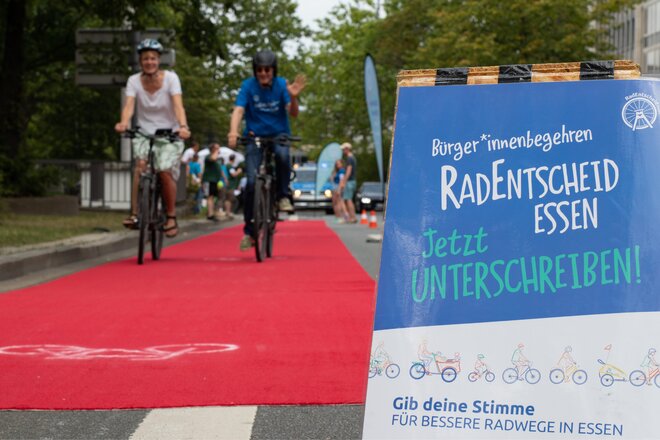
The CDU and SPD want to change the city of Essen’s transportation policy guidelines now, effectively backing out of the “RadEntscheid” initiative and the cycling promotion measures it established.
Essen can do better: Safer routes to school. Less traffic. Getting to your destination faster. Quieter streets. Cleaner air. Investments in good mobility for everyone that are worth it.
Sign! Share! Join in!
For an Essen where everyone arrives safely.
Vielen Dank für Ihre Unterstützung, Daniel Garcia, Essen
Frage an den Initiator
Petition teilen
Angaben zur Petition
Petition gestartet:
20.03.2026
Sammlung endet:
17.09.2026
Region:
Essen
Kategorie:
Verkehr
Diese Petition wurde in folgende Sprachen übersetzt
Petition teilen
Diese Petition wurde in folgende Sprachen übersetzt
Mehr zum Thema Verkehr

Verkehr
Rethinking Torstraße to make it more vibrant - Shaping the future together with the residents
11.363
Unterschriften
69 Tage
verbleibend


257
Unterschriften
153 Tage
verbleibend