Neuigkeiten
-
Changes to the petition
am 26.06.2025 -
Changes to the petition
am 13.06.2025
Petition richtet sich an: Stadtverwaltung Mainz, konkret das Dezernat für Umwelt, Grün, Energie und Verkehr sowie ggf. das Amt für Verkehrsmanagement – in Zusammenarbeit mit dem Landesbetrieb Mobilität Rheinland-Pfalz (LBM).
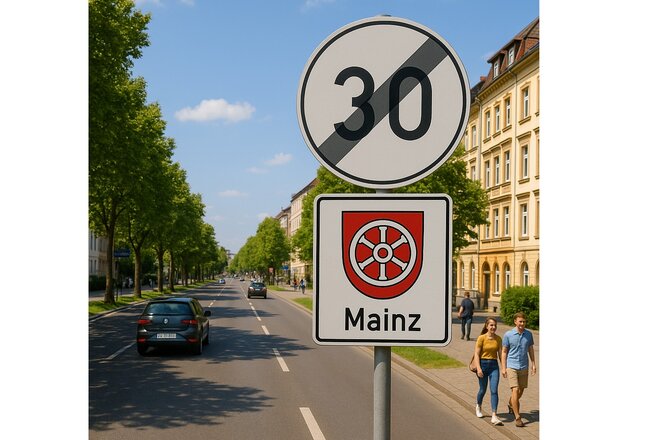
We demand the reinstatement of the standard inner-city speed limit of 50 km/h on Rheinallee in Mainz – for greater efficiency, personal freedom, economic reason, and a fact-based traffic policy.
1. 50 km/h is the legally defined standard speed within city limits
The introduction of a 50 km/h limit in urban areas is based on a nationwide and well-established traffic framework that balances safety, traffic flow, and everyday practicality. Departing from this standard without compelling factual reasons constitutes an unnecessary deviation from the established norm.
2. No clear evidence for environmental benefits of 30 km/h zones
A study by the State Institute for the Environment of Baden-Württemberg shows: 30 km/h limits do not significantly reduce emissions of nitrogen oxides or particulate matter, especially in flowing traffic. On the contrary, more frequent braking and acceleration can even be counterproductive.
3. Efficient traffic flow is not a luxury, but a necessity
In an era where mobility is part of daily life, smooth traffic flow is essential for workers, families, delivery services, and emergency responders. Artificial slowing down leads to lost time, increased stress, and ultimately: reduced quality of life – not more.
4. Economic impact must not be underestimated
Local businesses along Rheinallee and Kaiserstraße rely on accessibility – for customers, suppliers, and staff. Slower traffic can lead to economic decline, especially when parking and driving comfort have already been reduced.
5. Strengthening personal freedom and individual responsibility instead of overregulation
Not every street needs to be turned into a "traffic-calmed zone." Those who consider 30 km/h necessary can rely on many existing regulations in residential areas or near schools – but Rheinallee is a major traffic artery, not a playground.
6. 50 km/h does not automatically mean more noise – modern vehicles are quieter than ever
The often-cited noise reduction argument for 30 km/h is not universally supported by evidence. What matters is not the speed limit, but the traffic flow.
In urban traffic, the main noise source is not the engine but the tire rolling noise – and this differs only slightly between 30 and 50 km/h. Residents often subjectively report “less noise” when traffic flows smoothly – which is more likely at 50 km/h.
7. 30 km/h means an unreasonable burden on citizens – with increased risk of fines and existential consequences
A 30 km/h limit means that even minor speeding violations of a few km/h can result in significantly higher fines, penalty points, or even driving bans. Especially in cities with tight tolerances and automated enforcement, daily commuting becomes a speed trap – for people just going about their normal routines.
In Mainz in particular, where the city administration is known to generally favor expanding 30 km/h zones, it creates the impression that citizens are being deliberately targeted for revenue. Two fixed speed cameras are already installed on the affected Rheinallee. There is a justified suspicion that the reintroduction of a 30 km/h zone may be fiscally motivated – disguised as a health or safety measure.
For many people who depend on their driver’s license – such as commuters, field staff, tradespeople or caregivers – a driving ban can be existentially threatening. Traffic policy must not interfere with people’s livelihoods, but must be proportionate, fair, and transparent.
Sources for key points:
• Emissions at 30 km/h vs. 50 km/h: German Bundestag
• Basis for removal of the 30 km/h zone in Mainz: SWR + tagesschau.de
• Noise protection through 30 km/h zones: BYC-News Online Newspaper